August 13, 2026
How to Choose the Right Dog (Not Just the Cutest One)
The right dog for you is the one that matches your actual daily life — your space, schedule, activity level, and experience — not the breed that simply looks the cutest. Match temperament and energy needs first, then narrow down by allergies, grooming tolerance, and whether a breeder, shelter, or rescue is the better path for you.

The right dog for you is the one that matches your actual daily life — your space, schedule, activity level, and experience — not the breed that simply looks the cutest. Match temperament and energy needs first, then narrow down by allergies, grooming tolerance, and whether a breeder, shelter, or rescue is the better path for you.
Every dog is adorable in a photo. That's part of the problem.
Scroll through enough rescue pages or breeder sites and it's easy to fall for a face — a floppy-eared puppy, a fluffy senior with sad eyes, a breed you've always thought looked cool. But the dog you fall for online and the dog who actually fits your life aren't always the same dog. Getting that match right is the difference between a decade-plus of genuine partnership and a dog who ends up back in a shelter through no fault of their own.
Here's how to choose the right dog breed for your life, step by step.
1. Start with your actual life, not your ideal life
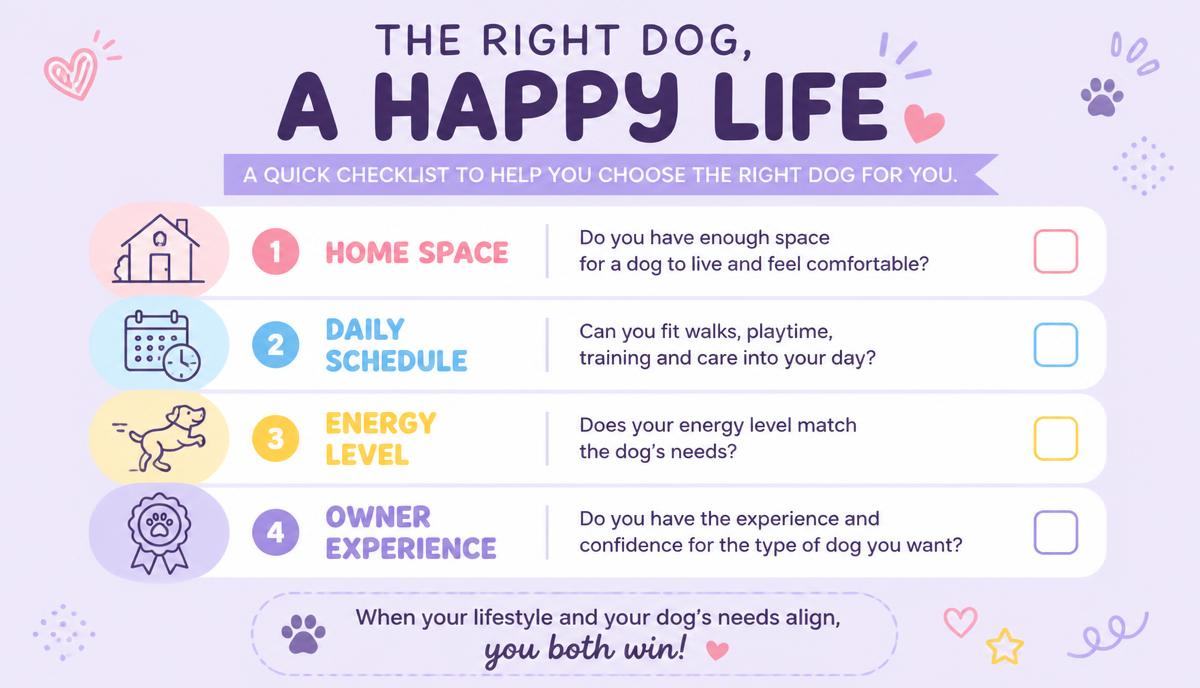
It's tempting to picture the dog you'll have in a few years — once you've moved somewhere bigger, once your schedule calms down, once the kids are older. Don't. Match the dog to the life you're living right now.
Be honest about:
- Your space. Apartment, house with a yard, rural property — size matters less than you'd think, but layout and noise tolerance (neighbors, thin walls) do.
- Your schedule. How many hours a day is the dog alone? Who's around to walk, feed, and train them?
- Your energy. Do you want a running partner, or a dog who's happy with a couple of relaxed walks and a nap?
- Your experience. First-time owner? Some breeds are far more forgiving of trial and error than others.
A big yard doesn't automatically mean a dog will be happier. Some large breeds are couch potatoes, and some small breeds need serious daily exercise — it's about energy match, not square footage.
2. Think about temperament, not just looks
Every breed carries general tendencies — trainability, independence, wariness of strangers, tolerance for other animals — and it's worth learning them before you fall for a look. Some breeds live to please and pick up commands fast. Others are independent thinkers who need patience and consistency to bring out their best.
Individual dogs, even within the same breed, vary widely based on genetics, upbringing, and personality. Breed traits are a helpful starting point, not a guarantee.
3. Factor in allergies and grooming honestly
"Hypoallergenic" dogs don't exist in an absolute sense. Some breeds shed less and produce fewer allergens, though, which can make a real difference for allergy-prone households. Separately, ask yourself how much grooming you're actually willing to do. A dog who needs daily brushing or regular professional grooming is a real ongoing commitment, not a one-time cost.
4. Don't rule out rescue
If you've got your heart set on a specific breed, adoption might still be the answer. Roughly a quarter of dogs in shelters are purebred, and breed-specific rescue groups exist for almost every breed out there. Rescues and shelter staff also tend to know their dogs' personalities well — often better than a generic breed description ever could.
5. Meet before you commit
However you narrow things down, don't skip the in-person step. Talk to breeders, shelter staff, or rescue organizations who actually know the individual animal, and arrange a meet-and-greet to see how you connect. Photos and personality quizzes can point you in the right direction, but they can't tell you how a particular dog will feel curled up next to you on the sofa.
It's also worth checking local regulations before you fall in love with a specific breed — things like breed-specific legislation or housing restrictions can affect what you're able to bring home.
The bottom line
Choosing a dog well means being honest about your life first, and open-minded about what breed (or mix, or rescue) actually fits it — rather than chasing the first cute face you see. A little upfront thinking goes a long way toward starting the relationship on solid ground.
Not sure where to start? Take the 2-minute quiz and get matched with breeds that genuinely fit your world.
Curious about a specific breed? Read our Labrador Retriever spotlight to see what that popular pick is really like day to day, or our Greyhound spotlight for a calm, low-energy alternative.
Already chosen your dog? Read our new-dog preparation guide so you're ready before they come home.
Guidance only — every dog is an individual. Always meet a dog, talk to reputable breeders or rescues, and consider adoption first.